
The collegium, also comprising Justices Sanjay Kishan Kaul, Sanjiv Khanna, B R Gavai and Surya Kant, recommended the names of Delhi high court Chief Justice Satish Chandra Sharma, Rajasthan high court Chief Justice Augustine George Masih and Gauhati high court Chief Justice Sandeep Mehta as top court judges.
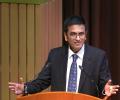
Newly sworn-in Chief Justice of India DY Chandrachud on Monday asked Supreme Court and high court judges to shun "colonial mindset" and the "culture of subordination" while dealing with district court judges, saying the country needs to move towards a "more modern and equal judiciary".

Supreme Court judge Justice D Y Chandrachud has termed the delay in communicating bail orders to prison authorities as a "very serious deficiency" and stressed the need to address it on a "war footing" as it touches the "human liberty" of every undertrial prisoner.

Democracy does not begin and end with elections and the integrity of election process is pivotal for sustaining the democratic form of government, the Supreme Court said on Thursday while striking down as unconstitutional the electoral bonds scheme for political funding.

It is crucial to electoral democracy that the exercise of freedom to vote is not subject to undue influence, the Supreme Court said on Thursday while striking down as unconstitutional the electoral bonds scheme for political funding.
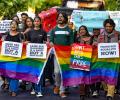
A five-judge bench of the Supreme Court will consider review pleas challenging the October 2023 verdict that declined legal sanction to same-sex marriage. The review pleas will be heard in chambers on January 9, with Justice P S Narasimha being the only member of the original bench that delivered the verdict.
Holding that the electoral bonds scheme was not fool-proof, the Supreme Court said on Thursday that information about funds received by a political party is essential for voters to exercise their freedom to vote effectively.
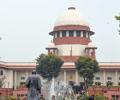
The Supreme Court on Thursday dismissed a batch of pleas seeking to review its October 2023 verdict declining legal sanction to same-sex marriage.
The division bench of the high court noted that certain allegations have also been levelled against them in the petition, and said it cannot hear the case.
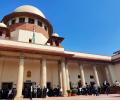
With the appointment of the five judges, the total number of judges in the apex court has risen to 32, two short of the full strength.

As part of the procedure, the law minister writes to the CJI to name his or her successor.

The Supreme Court has allowed podcaster Ranveer Allahbadia to travel abroad after the Assam and Maharashtra governments said the investigation against him was complete. Allahbadia, known as BeerBiceps, was booked for his comments on parents and sex on comic Samay Raina's YouTube show "India's Got Latent".

Asserting that he prays regularly, the CJI said, "Believe me, if you have faith, God will always find a way."

On February 1, grappling with the intractable issue of the AMU's minority status, the top court said the 1981 amendment to the AMU Act, which effectively accorded it a minority status, only did a "half-hearted job" and did not restore the institution the position it had prior to 1951.
The Collegium had proposed Justice Singh's transfer on August 3 for "better administration of justice".

'The ruling does not automatically mean that your house can be taken away, but suppose it blocks an expressway or a highway or such essential development, then it can be taken away as long as there is a law to support that action.'

While naming him as the NDA candidate for the Vice President's post, the BJP had described him as 'Kisan putra', a move seen in the political circles aimed at reaching out to the politically significant Jat community which had participated in huge numbers in the year-long farmers' protests against agriculture reform measures unveiled in June 2020.

Disagreeing with the Centre's submission that the petitions seeking legal validation of same-sex marriage reflected an 'urban elitist' view, Chief Justice of India D Y Chandrachud said on Tuesday queerness is not urban or elite, or restricted to upper classes and privileged communities.
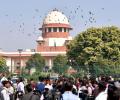
Chief Justice Chandrachud said the court will allow the lead counsel from the petitioner's side to argue on all aspects and rest of the counsel can add on certain aspects, so that there are no overlapping arguments.

Glimpses from the At Home reception hosted by President Droupadi Murmu at Rashtrapati Bhavan on Republic Day.
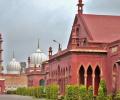
There is nothing "fundamentally inconsistent" with a minority institution being an institution of national importance (INI), the Supreme Court said on Wednesday while hearing arguments on the vexed issue of minority status to Aligarh Muslim University (AMU).
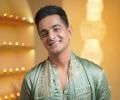
Podcaster Allahbadia's remarks on parents and sex on comedian Samay Raina's YouTube show 'India's Got Latent' triggered a controversy and several FIRs have been lodged against him and others in various parts of the country.

The CJI also said merits of a case may be quite different from what is shown in the media when asked about the delay in hearing on the bail plea of former Jawaharlal Nehru University student Umar Khalid, lodged in jail in a Delhi riots case.
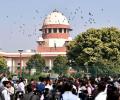
"This is complete abuse of the process," said the bench comprising Chief Justice D Y Chandrachud and justices JB Pardiwala and Manoj Misra while junking the PIL on the issue.

According to the CJI, once someone has a sense of faith in his/her intentions and abilities, it is easier not to obsess over outcomes but to value the process and the journey towards those outcomes.

Chandrachud said it should be ensured that courts provide safe and accommodating environment for all members of the society.

The CJI also dealt with the principle of affirmative action by the state and said it was meant to achieve broader equality and was not against the right to equality.

A five-judge Constitution bench of the Supreme Court, by a 3:2 majority, on Tuesday upheld one of the adoption regulations prohibiting unmarried and queer couples from adopting children.
Writing a 247-page separate judgement, Chief Justice of India DY Chandrachud struck down Regulation 5(3) of the CARA, saying it is violative of the rights of the queer community and that the CARA has exceeded its authority in barring unmarried couples from adopting children.
'A rigid or overly broad interpretation could lead to a chilling effect on investments and growth in sectors traditionally driven by private initiative.' 'Entrepreneurs may fear that their assets could be arbitrarily appropriated by the State under the guise of serving the 'common good' without sufficient legal safeguards.' 'The judgment thus supports a more nuanced view, one that balances individual property rights with public welfare objectives.'

Chief Justice of India Sanjiv Khanna on Tuesday recused from hearing a batch of pleas challenging the exclusion of the CJI from the panel meant for selecting the chief election commissioner and election commissioners. The CJI, who was sitting on the bench with Justice Sanjay Kumar, told the advocates appearing for the PIL petitioners that he couldn't hear the pleas now. The cases will now be listed before another bench after the winter break.
In an unprecedented development, the Supreme Court Collegium has made public the names of the two judges on the panel who objected to the method of 'circulation' adopted for eliciting the views of its members on the appointment of judges to the apex court.
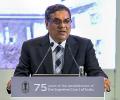
Justice Khanna was elevated as an additional judge of the Delhi high court in 2005 and was made a permanent judge in 2006. He was elevated as a judge of the Supreme Court on January 18, 2019.
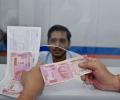
Not ordering disclosure of details of electoral bonds prior to April 12, 2019, was a "conscious choice" by the Constitution bench, the Supreme Court said on Monday while refusing to entertain the submissions of ASSOCHAM and CII against the disclosure of bond details on the ground of their plea not being listed.

Grappling with the intractable issue of Aligarh Muslim University's minority status, the Supreme Court said on Thursday the 1981 amendment to the AMU Act, which effectively accorded it a minority status, only did a "half-hearted job" and not restore to the institution the position it had prior to 1951.

Modi also said that Lord Ganesh was "put behind bars" in Karnataka by these people.

The State Bank of India, which unsuccessfully sought extension of time till June 30 to disclose the details of electoral bonds, on Monday faced searching questions from the Supreme Court which wanted to know about the steps taken to comply with the directions it had issued while scrapping the controversial scheme of anonymous political funding on February 15.
'This government is not in the hands of M K Stalin but in the hands of the bureaucracy -- the IAS and IPS.'
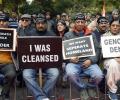
The mass exodus of the Kashmiri Pandit community changed the very cultural ethos of Kashmir and there has been little turnback despite three decades having gone by since it got triggered by growing fundamentalism fuelled from across the border, Supreme Court judge Justice Sanjay Kishan Kaul said on Monday.
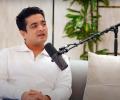
A bench of Justices Surya Kant and N Kotiswar Singh took note of Allahbadia's submission that the podcast was his only source of livelihood and around 280 people employed by him were dependent on the show.
